
How Much Does a Personal Trainer Cost in Sydney?
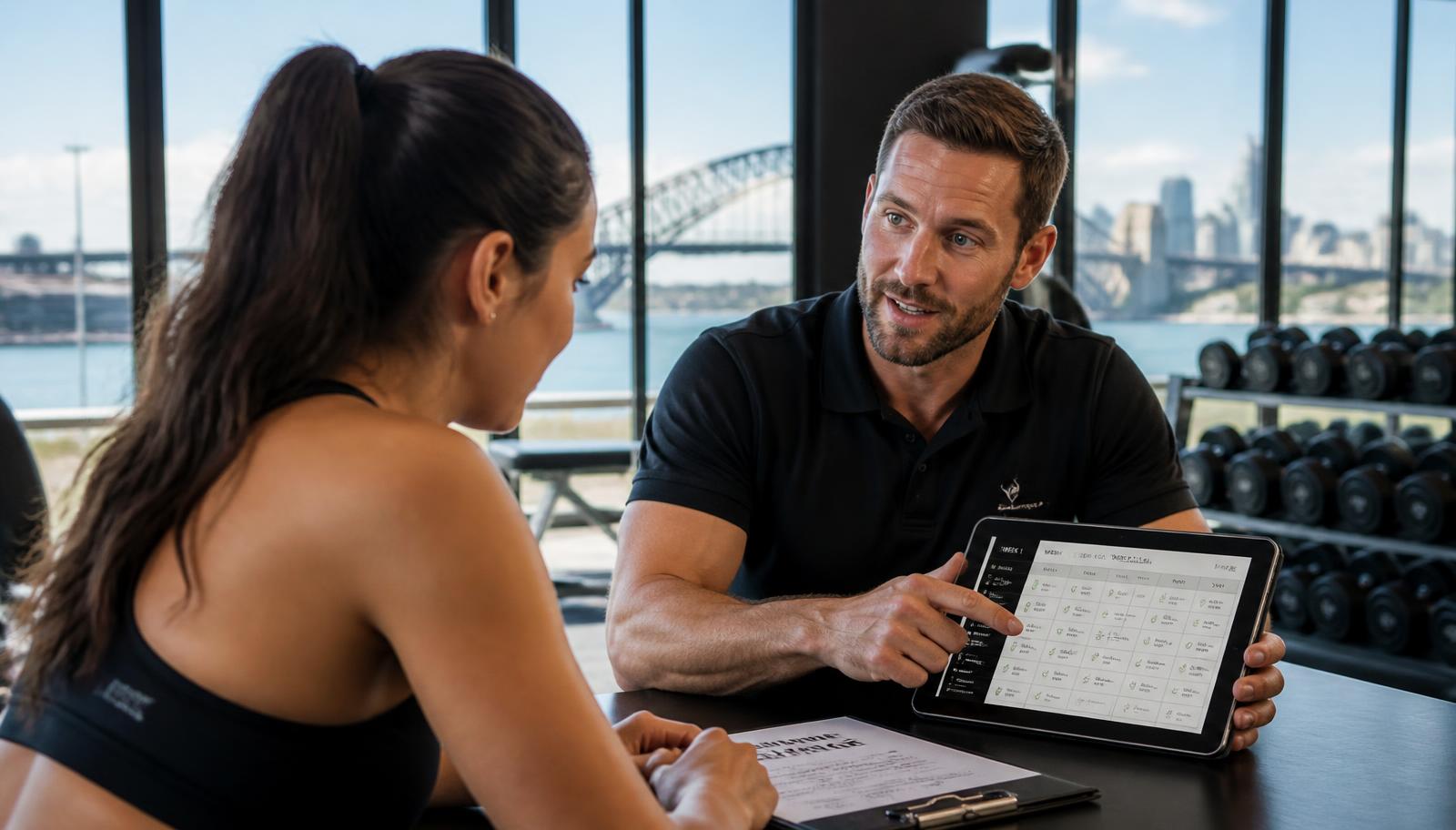
Price is the make or break for a lot of people when it comes to hiring a good personal trainer. You could have the smartest trainer in the gym, with accolades and adoring fans aplenty. It doesn't mean anything if you can't budget for the cost. And let's be honest, it's a discretionary spend that many cannot enjoy to the fullest.
To dial up the difficulty some more, plenty of Sydney trainers won't publish their rates at all, which leaves you calling around, comparing offers that are not comparable, and guessing what's fair.
Pulled from published data, below you will find what sessions currently cost across Sydney city, why the spread is so wide, how package pricing works, and how to turn all of that into a monthly number you can live with.
One caveat: there is no official tariff for personal training in Australia, and no industry body publishes an audited rate card. The figures here come from providers who publish their prices and from national quote data, and they are cited so you can check them yourself. Treat them as a market snapshot, not a fixed price.
The short answer
In Sydney, a one-on-one hour with a qualified trainer typically lands between $75 and $120, with 30-minute sessions from around $46 and premium CBD specialists above $125.1 Nationally, quote data puts the median personal training session at $70 and the full spread at $15 to $130,2 with industry commentary citing $60 to $120 an hour as the usual band.3
For most people training twice a week, the realistic budget is $600 to $1,000 a month, before any gym membership. That number moves a long way depending on the format you choose, which is where the rest of this article diverges a bit.
What a session costs in Sydney, by session length
A July 2026 audit of nine Sydney providers with published prices, spanning council leisure centres, suburban clubs and CBD studios, produced the following.1
| Session length | Published Sydney range | Examples | Typically suits |
|---|---|---|---|
| 30 minutes | $46 to $71 | DOOLEYS Lidcombe from $46 in a pack; City of Sydney Leisure $71 single | Time-poor clients, strength-only sessions, adding a second weekly touchpoint |
| 45 minutes | $80 to $130 | Fit Woman Academy $85 single; Sydney Bespoke Trainer $125 in the CBD | The default at private studios; enough time for a full session without the hour price |
| 60 minutes | $75 to $117.50 | DOOLEYS $85 single, $75 in a 10-pack; Inner West Council $117.50 single | Beginners needing coaching time, rehab work, anyone training once a week |
| Small group (2 to 4) | About $20 to $71 per person | Varies by group size, duration and commitment | Training with a partner, or getting coached eyes on you at a lower unit cost |
Two things stand out. First, a 45-minute session at a private studio often costs more than a full hour at a council leisure centre, so comparing on price per session without checking the clock will mislead you. Second, the cheapest options in the city are not bad options: council-run leisure centres and suburban clubs employ qualified trainers and simply carry lower overheads.
Why the cost is so broad
A $46 session and a $130 session are both real prices in Sydney. The difference is rarely about who is the better coach. It comes down to:
- Rent and location. A Barangaroo or CBD studio pays commercial rent per square metre that a Lidcombe club or an outdoor Bondi setup does not.
- The gym's cut. Trainers working inside a chain gym often surrender a share of every session, or pay a fixed rental for the right to train clients on the floor, and the rate reflects it.
- Experience and specialisation. Post-rehab work, pre and post-natal, strength coaching and clinical exercise physiology all command more, and the qualifications behind them cost more to obtain.
- Session length and time of day. Six-to-eight in the morning and after work are the scarce slots, and they price accordingly.
- What is bundled. A rate that includes programming for your solo days, nutrition support and regular reassessment is not the same product as an hour of supervised training.
That last point is the one most people miss when they compare quotes, and it is worth managing expectations.
How packages work, and why the bulk discount is fading
Buying in blocks is still the norm, and at many Sydney venues it does bring the unit price down. At the City of Sydney's leisure centres, a $112.60 hour drops to $92.38 in a 10-pack. At Inner West Council, $117.50 becomes $96.90. DOOLEYS moves from $85 to $75, and a CBD specialist charging $125 for 45 minutes comes back to $115 across a 20-session block.1 Discounts of roughly 8 to 22 per cent per session are typical when they exist.
The important word is "when". Personal training has become a far more business-literate industry over the last decade. Trainers now run their numbers, know their capacity, and understand that a full book at full rate beats a full book at a discount. Some Sydney studios publish a 10-pack with no reduction at all,1 and a growing number of trainers will politely decline to cut their hourly rate no matter how many sessions you buy.
What the sharper operators do instead is add value to the block. Rather than shaving $10 off the session, they will include things that cost them scale rather than margin: a written program for the days you train alone, app access with video demonstrations, nutrition guidance, monthly body composition or performance reassessment, check-in messages between sessions, or priority on the peak-hour slots. One Barangaroo studio prices its packages this way, bundling programming, nutrition guidance and progress reporting rather than competing on unit price.1
This is usually a good sign rather than a bad one. A trainer who will not discount often has a waiting list, a clear sense of what an hour of their time is worth, and no need to buy your commitment. A trainer who drops 30 per cent the moment you hesitate may simply have empty slots. Neither is proof of quality on its own, but there's typically a pattern worth looking into. Discounting blocks on a strategy of "everyone else does it" doesn't make a tonne of business sense when the time and effort investment is the same.
Comparing a discount against a value-add
The trap is comparing a discounted offer to a bundled one on headline price alone. Price them on what you receive, at market rates, over the same period.
| What you're offered | Offer A: the discount | Offer B: the value-add |
|---|---|---|
| Headline rate | $110 per hour | $110 per hour |
| 10-session block price | $950 ($95 per session) | $1,100 (no discount) |
| Program for solo training days | Not included | Included |
| Nutrition guidance | Not included | Included |
| Reassessment and progress reporting | Not included | Included |
| Between-session check-ins | Not included | Included |
| Effective value | $150 saved | Inclusions you would otherwise pay separately for |
If you train once or twice a week and do nothing in between, the discount is worth more to you. If you plan to train on your own between sessions, which is where most of the progress in a week happens, the inclusions usually win. Ask "what's included" before you ask "what's your best price": the answer tells you more about the trainer, and it gives them room to offer you something better than money off.
What it costs per month
Session price is abstract. The monthly figure is what determines whether you stick with it, so run the number before you commit.
| Frequency | At $75 per session | At $95 per session | At $115 per session |
|---|---|---|---|
| Once a week | About $325 a month | About $412 a month | About $498 a month |
| Twice a week | About $650 a month | About $823 a month | About $997 a month |
| Three times a week | About $975 a month | About $1,235 a month | About $1,495 a month |
Add membership where it applies. Virgin Active's Premium and Life memberships run $62 to $72 a week on a 12-month term and $72 to $86 a week on a 12-week term, depending on the club.4 That is a meaningful second line item, and it is the reason mobile and outdoor trainers, who need no venue, often work out cheaper overall even at a similar hourly rate.
The costs that do not appear in the headline rate
Published per-session prices are only part of the contract. The terms attached to them are where people get caught. Virgin Active's published personal training terms are a useful example of what is standard across the industry:5
- Cancellation windows. Give less than 24 hours' notice, and you are charged the full session. Reasonable, and worth knowing before your work calendar collides with it.
- Package expiry. Prepaid sessions expire. Under those terms, a starter pack must be used within four weeks and a 10-pack within twelve. A bulk discount is worth nothing if the block lapses before you use it.
- Minimum terms. Direct-debit personal training can carry an initial commitment, in that case twelve weeks, rolling on fortnightly until you cancel with notice.
- Refunds and transfers. Refunds are commonly limited to documented medical reasons, and sessions usually cannot be transferred to another person.
None of this is predatory, but all of it is negotiable at the margins, and none of it should be a surprise. Independent trainers often run looser terms than the big clubs. Ask for the cancellation policy and the expiry date in writing before you pay for a block, and put those questions alongside the rest of the questions worth asking a trainer before you hire them.
How to spend less without training worse
If the numbers above are out of reach, the answer is not to give up on coaching. It is to buy less of it, more precisely.
- Train semi-private. Two or three people sharing a trainer cuts the per-person cost sharply while keeping eyes on your technique.
- Buy 30-minute sessions. At $46 to $71 in Sydney, a focused half hour twice a week can beat a single expensive hour, especially for strength work.
- Pay for programming, not supervision. Some trainers will write and update your program for a monthly fee while you train solo, with an in-person session every few weeks to check form.
- Front-load, then taper. Train twice a week for eight to twelve weeks to build technique and habit, then drop to fortnightly check-ins once you know what you are doing.
- Look outside the CBD and outside peak hours. The same qualifications cost less in a suburban club at 10 am than in a harbourside studio at 6 am.
- Check council leisure centres. Their published rates are among the lowest in the city, and their trainers are qualified employees.
Is it worth it?
Honestly, not for everyone. If you already train consistently, know how to progress a program, and are not carrying an injury, a trainer is a nice-to-have rather than a need. Your money may do more as a gym membership plus a one-off program written for you.
Personal training earns its price in three situations: when you are starting from scratch and technique matters, when you have an injury, a medical condition or a pregnancy that makes generic programming risky, and when you know from experience that you will not turn up unless someone is expecting you. In those cases, the cost per session is the wrong lens. The right one is the cost of another year of not training, or of a back injury from a poorly performed and uncoached deadlift.
If you decide it is worth it, the next step is finding someone good rather than someone cheap. Our guides on how to choose a personal trainer and how to find a personal trainer in Sydney cover what to look for, and you can browse trainers by suburb or use our find my trainer tool to shortlist a few and start asking about price with some context behind you.
References
- 1. Fitness Image. (2026, July 18). Personal Trainer Prices In Sydney: What You Will Really Pay. Audit of published prices from nine Sydney providers, conducted 17 July 2026. https://fitnessimage.com.au/personal-trainer-prices-sydney/
- 2. Airtasker Australia. (2025, March 26). How Much Does a Personal Trainer Cost? Australia-wide quote data: $15 to $130 per session, median $70. https://www.airtasker.com/au/costs/personal-training/personal-trainer-cost/
- 3. Lazenby, A. (2026, February 13). How much should a PT session cost? Fitness Network. Reports an Australian range of $60 to $120 per hour. https://www.fitnessnetwork.com.au/how-much-should-a-pt-session-cost/
- 4. Virgin Active Australia. Gym Membership Options. Premium and Life memberships listed at $62 to $72 per week on a 12-month term and $72 to $86 per week on a 12-week term, varying by club. https://www.virginactive.com.au/membership-info
- 5. Virgin Active Australia. Personal Training Terms (document 910-13). Published cancellation, package expiry, minimum term and refund conditions. https://assets-us-01.kc-usercontent.com/a07c5ec0-e08a-0014-c8c5-a7a73768c21f/2bda58bc-2913-41cd-a557-a45c1ddbc0ac/910_PT%20Agreement%20Terms_13.pdf
Want the cost comparison and budget worksheet?
Grab the free printable PDF: the Sydney price ranges in one table, a simple monthly budget calculator, and the pricing questions to ask before you hand over a card.
Download the free worksheet